
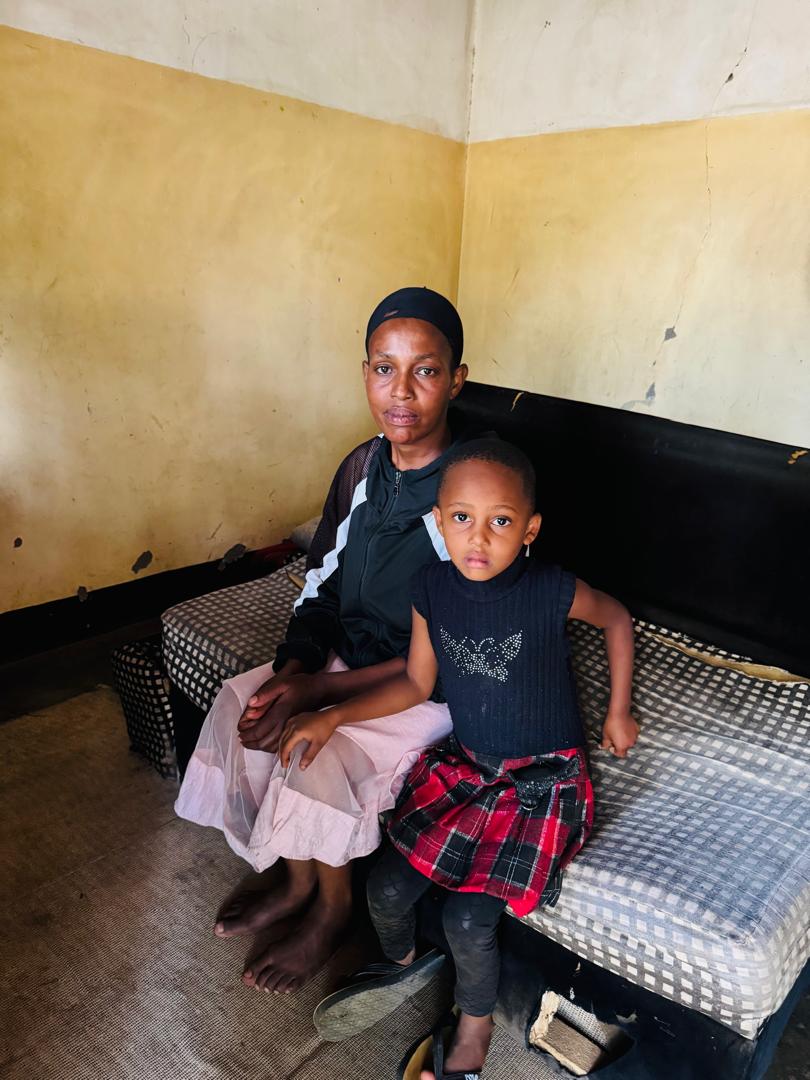
Happy Sylvester (Mama Grace)
Happy’s Sylvester Story (Mama Grace)
is a story of a 43 year old single mother of three children called Happiness. She is the firstborn in a large family and has had hardship for most of her life. From childhood, her home was not a place of safety. Her father was often violent and abusive, and the family lived under constant fear. In 1999 Happy’s mother became mentally ill, and over time her condition worsened until she eventually passed away. As the years went on, the family scattered one by one, each trying to escape the difficult environment at home.
As a young woman, Happy got married and had three children with her first husband. But the marriage was marked by abuse and mistreatment. At times, her husband would threaten her with sharp objects. Eventually, Happy made the painful decision to leave the marriage. ( At Neemaa Village we teach a class every month on Women’s Rights teaching African women they have the right not to be beaten.)
Later, Happy married another man and moved to Karatu working as a house helper. It was there that she discovered that the man was already married. She ended that relationship which left her once again facing life alone.
Happy later moved to Arusha, where she tried to rebuild her life. She worked on other people’s farms and stayed temporarily with a woman who offered her a place to live. Eventually, she was able to rent a place of her own. To survive, she now takes whatever work she can find, mostly cleaning other people’s homes. Desperate, one time she even took a job at a bar but they fired her when she refused to sleep with male customers who came there.
Last year 2025, Happy fainted and was rushed to the hospital. After further testing, doctors discovered that she has the sickness. The diagnosis added another layer of fear and uncertainty to an already difficult life. By that point, she was already struggling to provide even the most basic needs for her family. Work had become scarce, and with many others also doing house cleaning jobs, it became harder and harder to earn enough money to survive.
On our initial visit with Happy in her home ,with tears in her eyes, Happy shared that there was a time when she had a bed in her home. But after being abandoned and overwhelmed by financial pressure, she had to sell it. The mattress was eventually sold as well. Today, she and her children sleep on couch cushions placed on the floor. She is also behind on three months of rent, and there have been days when she has had no food at all. At one point, her landlord wanted to evict her, but when he saw how sick she had become, he allowed her to stay until she recovered.
Happy says she had heard about Neema Village before, but never came because she still believed she could somehow manage on her own. It was only when she found herself completely empty with no food, no stable income, and no way to pay rent that she finally reached out for help to Neema Village.
Happy needs stability, healing, and close support, we have welcomed Happy into the MAP apartments for a season.
While staying at the apartments, Happy is receiving counseling and emotional support as she works toward healing and healthier choices. She has also joined the sewing class at MAP, where she is learning tailoring skills that can help her build a more stable future and create income for her family. Also she will be trained about women’s rights and also attend Bible study classes. Our hope is that this season will give Happy a safe environment to grow stronger emotionally, spiritually, and practically as she takes steps toward independence.
Like so many African women Happy’s story is one of deep pain, loss, and survival. Yet it is also a story of resilience. Even after years of abuse, abandonment, illness, and poverty, she has not given up. She continues to fight for her children and to hope for a different future. At Neema Village, we are honored to walk alongside her as she begins this next chapter of healing, restoration, and renewed hope.
It is extremely hard for women and children living in such poverty to lift themselves up without some kind of help. Neema Village offers these women hope and help.